
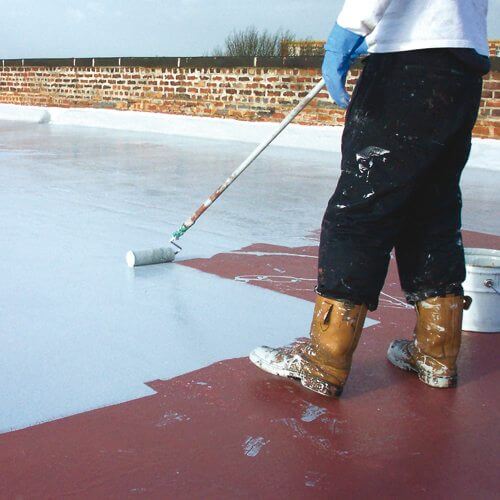
 A concrete waterproofing membrane is a continuous layer that keeps water from passing into or through concrete. It comes in two main forms: sheets that are rolled or stuck onto the concrete, and liquids that are rolled, brushed, or poured on and cure into a rubber skin. Sheets are the standard on the outside of new foundations. Liquid membranes are the practical choice for existing buildings, interior basement walls and floors, and any surface with corners, pipes, and odd shapes. This guide explains the types, how they fail, and how to apply a liquid rubber membrane to concrete.
Types of concrete waterproofing membranes
Sheet membranes
Sheet membranes include self-adhered rubberized asphalt, EPDM and PVC sheets, and bentonite clay panels. They are applied to the outside of foundation walls during construction, before the soil is backfilled, and are often paired with a drainage board and footing drain. A good sheet membrane on a new foundation works well.
The weak points are the seams, laps, and edges. Every overlap is a place where the sheet can lift, and backfill rocks and settling soil can puncture or tear it. When an exterior membrane fails on an existing home, the only way to replace it is to excavate down to the footing.
Liquid-applied membranes
Liquid membranes go on wet and cure into one continuous film with no seams. Common types include asphalt and rubberized asphalt coatings, acrylics, polyurethanes, and polyureas. They wrap around pipes, corners, and penetrations without cutting or lapping, and they can be reapplied or patched by adding more material.
They differ in how well they bond to concrete, how much they stretch, and whether they can be used on the inside face of a wall. Many liquid membranes are rated only for the outside face (the positive side), where water pushes the membrane against the wall.
Cementitious and crystalline coatings
These are brushed or troweled on and harden into the concrete surface. They are rigid, so they do not bridge cracks that open after they are applied. Compare them in crystalline waterproofing versus SANI-TRED and Thoroseal versus SANI-TRED.
Positive side versus negative side
Positive-side waterproofing goes on the face of the concrete that touches the water: the outside of a foundation wall, or the inside of a pool or pond. The water pressure pushes the membrane into the concrete.
Negative-side waterproofing goes on the opposite face, such as the inside of a basement wall. Here the water pushes against the back of the membrane and tries to blow it off. Paint and most surface coatings blister and peel in this position. A membrane used on the negative side has to anchor into the pores of the concrete deep enough to hold against that pressure.
This is the reason a basement that has been “waterproofed” with paint keeps peeling. The paint is on the wrong side of the water and has nothing holding it in place.
Why liquid rubber works as an interior membrane
SANI-TRED is a liquid rubber membrane built for both sides of the wall. The primer, PermaFlex, soaks deep into the concrete and cures into solid rubber plugs inside the pores. Those plugs work like tiny hydraulic o-rings: they anchor the coating and hold back water before it reaches the surface layer. The cured membrane stretches up to 590 percent and returns to its original shape, so it stays sealed as the concrete expands, shrinks, and cracks.
The membrane is built up in layers that bond to each other. LRB (Liquid Rubber Base) cures at any thickness, does not give off gas while curing, and molecularly welds to itself, so new material bonds to old with no weak seam. That makes the membrane easy to patch or thicken years later.
How to apply a liquid rubber membrane to concrete
1. Prep the concrete
The concrete must be clean, dry, and free of any previous paint, sealer, waterproofer, or other bond breaker. Remove loose and crumbling concrete. Acid etch or grind floors to open the surface (see how to acid etch concrete). Do not acid etch walls unless they were hand troweled.
2. Prime
Apply one coat of PermaFlex at 240 sq ft per gallon with a roller or brush. Block walls take two prime coats.
3. Patch and profile
Mix 2 parts LRB with 1 part TAV to make a caulk-like rubber patch. Fill cracks with a 3/4-inch bead and the wall-floor joint with a 1-inch bead. Fill holes and smooth rough areas. The mix cures to solid rubber in about 4 hours. The crack filling calculator estimates how much you need.
4. Build thickness where you need it
For floors, roofs, and other surfaces that take traffic or standing water, pour or squeegee a layer of LRB between the PermaFlex coats. LRB self-levels and cures throughout its full thickness in 4 hours or less at 70°F and above. At 40 sq ft per gallon, one coat goes down about 40 mils thick wet. Use the mil thickness calculator to plan coverage.
5. Topcoat
Finish with one coat of PermaFlex at 240 sq ft per gallon. Primer, patches, LRB, and topcoat bond into one seamless rubber membrane. Add rubber texture granules for grip on walking surfaces, or paint over the membrane on walls you plan to finish.
Where a liquid concrete membrane makes sense
- Basement walls and floors on existing homes, where digging out the foundation is not practical. See the basement waterproofing system.
- Swimming pools, ponds, and fountains, where the membrane works as a roll-on liner. See pool repair and fountain and pond sealing.
- Flat roofs and decks. See waterproof roof coating.
- Tanks, elevator pits, and manholes. See tank coatings and elevator pit sealing.
- Animal habitat and kennel floors, where the floor is hosed down every day. See animal habitat flooring.
- Garage floors, driveways, and pool decks. See the garage floor coating system.
Membranes under decorative floors
 A rubber membrane also makes a good base under decorative coatings. In a flake or quartz broadcast floor, PermaFlex primes the slab, LRB/TAV fills the cracks, and colored flakes are broadcast into a second coat of PermaFlex before the surface is sealed. Because the base layer stretches, cracks in the slab are less likely to show through the finish. The same approach works on pool decks, sidewalks, and driveways. SANI-TRED also works as a primer under rigid floor systems like two-part epoxy, where it buffers the epoxy from moisture coming up through the slab. See slip resistant floor coverings for finish options.
Frequently asked questions
What is the best waterproofing membrane for concrete?
For new foundations, a sheet or liquid membrane on the outside before backfill. For existing concrete, especially basement interiors, a liquid membrane that bonds into the concrete and stays flexible. Check that the product is rated for negative-side use if water will push from behind.
Can you put a waterproofing membrane on the inside of a basement wall?
Yes, if the membrane anchors into the concrete. Surface films peel when water pushes from behind. SANI-TRED is made for interior basement walls and floors.
Is a liquid membrane better than a sheet membrane?
Liquid membranes have no seams or laps and wrap around pipes and corners easily. Sheets give a very even thickness and are fast on large, flat, new walls. For repair and interior work, liquid is easier.
How thick should a liquid waterproofing membrane be?
It depends on the product and the job. Follow the coverage rate on the label. A wall coated with SANI-TRED gets a PermaFlex primer, patches at the cracks and joints, and a PermaFlex topcoat. Floors and roofs that see traffic or ponding water get an added LRB layer.
What is a good alternative to an exterior foundation membrane?
An interior liquid rubber membrane on the walls and floor, combined with good outside drainage. It avoids excavation and covers the floor and cove joint, which an exterior membrane does not.
Get a SANI-TRED membrane on your concrete
SANI-TRED is a solvent free, non-flammable, low VOC liquid rubber system you can apply yourself. It cures into a seamless rubber membrane that holds back water under pressure, blocks 99 percent of radon gas, and carries a lifetime warranty on basement products.
- See the basic product line and the price list
- Estimate your project with the SANI-TRED calculators
- Order from the SANI-TRED shop
- Call 1-866-784-3308 to talk with a SANI-TRED tech