
Rubberized floor paint is a liquid rubber coating you roll onto concrete like paint. It cures into a flexible rubber skin instead of a hard film, so it moves with the slab and does not chip or crack the way regular floor paint does. For a basement, the waterproof versions soak into the concrete and hold back moisture coming up from below, which is what makes ordinary basement floor paint peel. This guide covers how rubber floor paint differs from regular and epoxy floor paint, how to tell if your floor has a moisture problem, and how to apply a waterproof rubber paint to a basement floor.
Why regular floor paint peels in a basement
A basement slab sits on soil that is almost always damp. Water vapor moves up through the concrete all the time, a process called moisture vapor transmission. When rain saturates the ground, liquid water pushes up through cracks and the joint where the wall meets the floor.
Latex porch and floor paint, and most one-part epoxy paints, form a thin film on top of the concrete. Moisture collects under the film, pressure builds, and the paint blisters and lifts. That is why basement floor paint often starts flaking within a year or two, usually in patches near the walls and over cracks.
Rubber floor paint vs. regular paint vs. epoxy
- Latex and acrylic floor paint is cheap and easy to apply. It sits on the surface, wears through in traffic lanes, and peels where moisture comes up through the slab.
- Two-part epoxy is hard and good-looking. It is rigid, so cracks in the slab crack the epoxy, and moisture under the slab can make it blister and delaminate.
- Rubberized floor paint cures into a flexible rubber layer. Quality varies a lot. Some products are thin rubber-like films that still sit on the surface. A true waterproof rubber paint for concrete soaks into the pores and anchors there.
SANI-TRED PermaFlex is the second kind. It is a one-part liquid polyurethane rubber that penetrates deep into the concrete and cures into tiny rubber plugs inside the pores. Those plugs anchor the coating and hold back water pressure from below. The cured coating stretches up to 590 percent and has 2,030 psi tensile strength. On a basement floor it does the job of a waterproofing membrane and a floor paint in one.
Test your basement floor for moisture first
Tape an 18-inch square of clear plastic sheeting flat on the bare floor, sealing all four edges, and leave it for at least 16 hours (a day or two is better). If the underside of the plastic is wet, or the concrete under it is darker, moisture is coming up through the slab. Ordinary floor paint will not hold on that floor. Other signs are white powdery efflorescence, a musty smell, damp spots after rain, and old paint that is already peeling.
Also check for cracks and for water at the wall-floor joint. Those need to be sealed as part of the job.
What you need
- PermaFlex for the primer and topcoat. One gallon covers about 240 sq ft per coat on concrete. Standard stocked colors are light gray and light tan.
- LRB (Liquid Rubber Base) and TAV (Thickening Activator) to fill cracks and joints
- Muriatic acid, a plastic watering can, a push broom, and baking soda for etching, or a floor grinder
- Roller frame, rollers, a squeegee, and a heavy-duty zip-loc bag for the patch mix
- Rubber texture granules if you want a slip-resistant finish
The basement waterproofing cost calculator works out how much material your floor needs.
How to apply waterproof rubber floor paint to a basement floor
1. Strip and clean the floor
Remove all old paint, sealer, carpet glue, and tile adhesive. The rubber has to soak into bare concrete to hold back water, so it cannot go over an old coating. Scrape, grind, or use a coating remover. Degrease oil spots, then sweep and vacuum.
2. Etch the concrete
Acid etching removes the smooth top layer of the slab and opens the pores. Dilute muriatic acid to a 10 percent solution, spread it on, and broom it in until the foaming stops. Rinse, neutralize with a baking soda solution, and rinse again. If the acid beads up instead of foaming, a sealer or oil is still on the surface. Follow our acid etching guide step by step. Grinding is an alternative. Let the floor dry completely.
3. Prime
Roll one coat of PermaFlex over the whole floor at 240 sq ft per gallon. Carry it a few inches up the walls so the floor and wall coatings overlap at the joint. Never thin PermaFlex with water or alcohol.
4. Patch cracks and the wall-floor joint
Mix 2 parts LRB with 1 part TAV into a thick, caulk-like rubber. Pipe a 1-inch bead into the joint where the wall meets the floor and a 3/4-inch bead into cracks. Smooth with a putty knife. The patch cures to solid rubber in about 4 hours. For low spots and rough, pitted areas, pour straight LRB. It self-levels and cures at any thickness.
5. Topcoat
Roll a topcoat of PermaFlex over the floor at 240 sq ft per gallon. The primer, patches, and topcoat cure into one seamless rubber membrane. For grip, broadcast rubber texture granules into the wet topcoat and lock them in with another coat. See slip resistant floor coverings for textures and finishes.
Finishing over a rubber-coated basement floor
Many people leave the PermaFlex as the finished floor, especially in storage areas, workshops, and laundry rooms. It is tough enough to scrub and pressure wash. If you want a finished room, the rubber makes a good base:
- Paint or epoxy. SANI-TRED works as a primer under two-part epoxy and other rigid floor systems. It buffers the epoxy from moisture and from movement in the slab.
- Decorative coatings. Flake and quartz broadcast systems, faux wood, and decorative concrete finishes can go on top. Zion Waterproofing Pros in Illinois waterproofed a leaky basement with SANI-TRED and then installed a faux wood concrete floor and a GraniFlex flake floor over it.
- Carpet, vinyl, and laminate. A dry slab underneath keeps padding and flooring from getting damp and moldy.
Wood flooring is the least forgiving choice in a basement. If you want the look of wood, waterproof the slab first and choose a product rated for below-grade use.
A basement floor project in Virginia
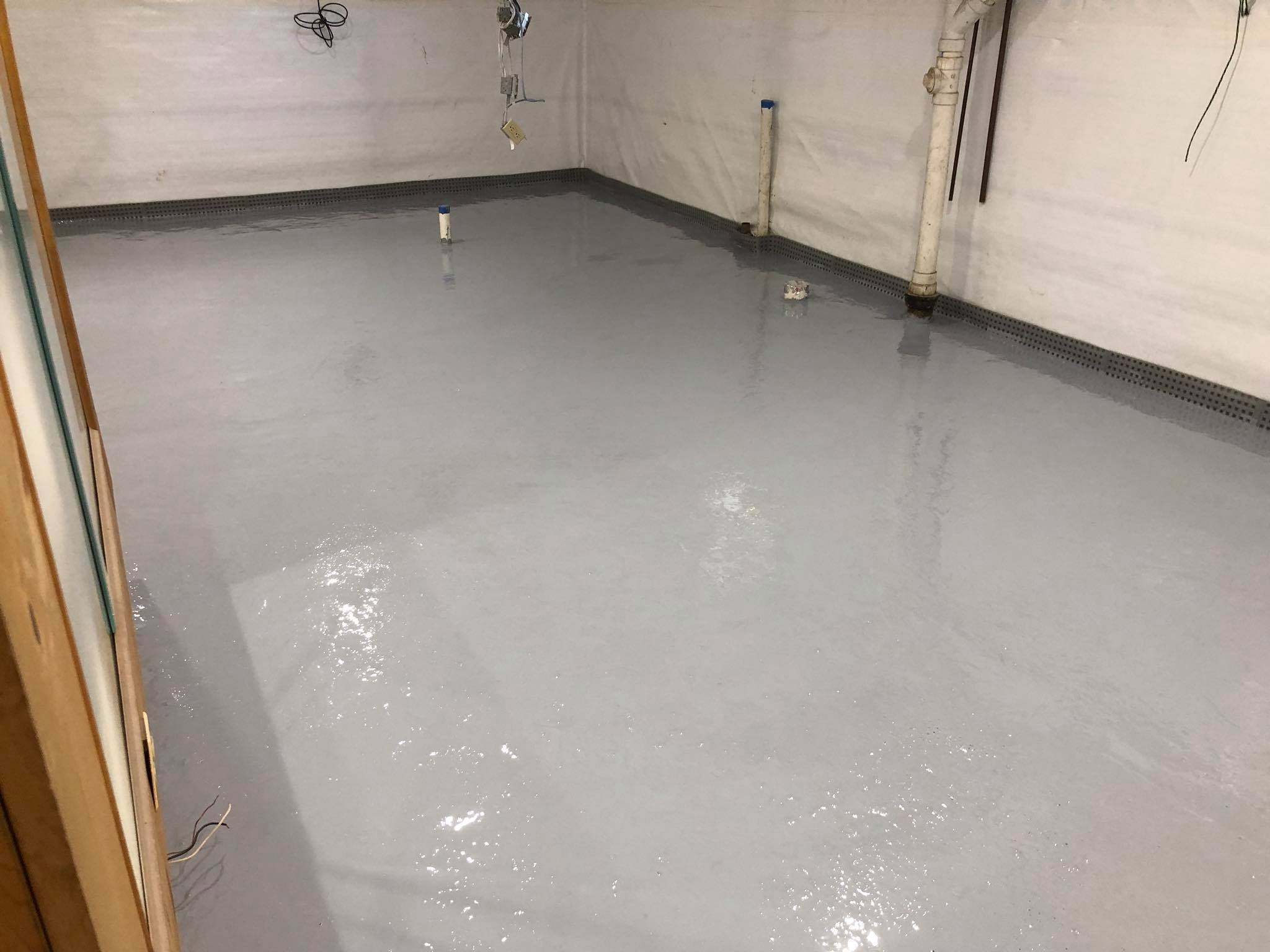
Superior Concrete Design of Culpeper, Virginia, was asked to put a waterproof floor paint system on a basement before the owner finished the space. They chose SANI-TRED to waterproof the slab and give the finished floor a solid, dry base.



Frequently asked questions
What is rubberized floor paint?
It is a liquid coating that cures into flexible rubber instead of a hard paint film. It stretches with the concrete, resists cracking and chipping, and some versions waterproof the floor.
Is rubber floor paint waterproof?
Some are. Look for a product that soaks into the concrete and is rated to hold back hydrostatic pressure from below. A rubber film that only sits on top can still blister when moisture comes up through the slab.
What is the best waterproof floor paint for a basement?
One that bonds into the concrete and stays flexible. Strip old coatings, etch the slab, seal cracks and the wall-floor joint, and use a coating made to resist negative-side water pressure.
Can you use rubber paint on concrete outdoors?
Yes. PermaFlex is used on garage floors, patios, pool decks, and driveways. It handles heat up to 250°F and freeze-thaw cycles. For outdoor surfaces, add texture for grip.
Can I put rubber floor paint over old paint?
Not if you want it to waterproof. The old paint will lift and take the new coating with it. Strip to bare concrete first.
How long does rubber floor paint take to dry?
Let the PermaFlex prime coat dry about 1 to 2 hours before patching. LRB/TAV patches cure in about 4 hours. Cooler, damp basements take longer, so give each coat time to cure before walking on it.
Waterproof your basement floor with SANI-TRED
SANI-TRED is a liquid rubber floor coating and waterproofing system in one. It blocks 99 percent of radon gas, is solvent free, non-flammable, and low VOC, and carries a lifetime warranty on basement waterproofing. Our techs walk DIYers through the job by phone.
- See the basement waterproofing system and indoor basement waterproofing
- Doing the garage too? See the garage floor coating system
- Read basement crack repair options
- Order from the SANI-TRED shop or check the price list
- Call 1-866-784-3308 to talk with a SANI-TRED tech
Sources: ASTM D4263, plastic sheet test for moisture in concrete.