
 The best basement waterproofing product is one that bonds into the concrete and stays flexible, so it can hold back water pushing from the soil side without blistering or cracking. For sealing walls and floors from the inside, that means a penetrating liquid rubber or polyurethane coating paired with a thick patching compound for cracks and the floor-wall joint. Masonry paints, cement coatings, and clear sealers cost less but are built for damp walls, not walls with water pressure behind them. This guide sorts the products and materials on the shelf by what they do, where they work, and where they fail.
What to look for in a basement waterproofing product
Before you compare brands, check any product against these questions:
- Is it waterproof or only water resistant? Water resistant products slow water down. Waterproof products stop it, including under pressure.
- Is it rated for negative-side (interior) use? Water in the soil pushes on the back of the wall. A coating on the inside face has to resist that push. Ask for test data on hydrostatic pressure.
- Does it penetrate or sit on the surface? Surface films peel when moisture builds up behind them. Products that soak into the pores hold on much better.
- Does it stay flexible? Concrete moves with temperature and settling. Rigid coatings crack with it. Check the elongation number on the data sheet.
- Will it bridge cracks and seal joints? Most leaks come through cracks and the floor-wall joint, so the system needs a thick patch material that bonds to the coating.
- Is it safe indoors? Look for solvent free, low VOC, and non-flammable, since you will be working in a closed basement.
- What does the warranty cover? Read whether it covers the product only, or a dry basement.
Waterproofing vs. dampproofing
Building codes treat these as two different things. Dampproofing, usually a thin asphalt coating sprayed on the outside of new foundation walls, slows moisture in soil that drains well. Waterproofing is required where the soil holds water or the water table is high, because it must resist water under hydrostatic pressure. A lot of homes were built with dampproofing only, and that thin black coating is often the first thing to fail.
Basement waterproofing products and materials, by type
Liquid rubber and polyurethane coatings
These are liquid-applied coatings that cure into a flexible rubber membrane. The better ones penetrate the concrete pores instead of sitting on top. Applied as a system with a primer, a thick patching compound, and a topcoat, they seal walls, floors, cracks, and joints into one continuous layer.
- Good for: interior walls and floors with active seepage, cracks, and floor-wall joint leaks; basements you plan to finish
- Limits: the surface must be bare and dry, so old paint has to come off; costs more per gallon than masonry paint
SANI-TRED falls in this group. More on it below.
Masonry waterproofing paint
These are thick acrylic or cement-modified paints sold in the paint aisle (DRYLOK is the best known). They fill surface pores and work on walls with light dampness.
- Good for: dry or slightly damp walls, light condensation, cosmetic improvement
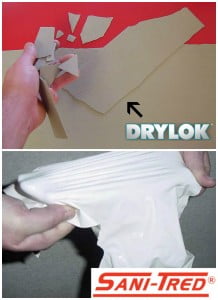
- Limits: they sit mostly on the surface and tend to blister, flake, and turn powdery when water pushes from behind; they do not bridge cracks; any later coating must go on bare concrete, so they have to be removed first
See SANI-TRED vs. DRYLOK for a direct comparison.
Cementitious coatings
These are powdered cement mixes you brush or trowel on, such as Thoroseal. They bond well to clean masonry and resist some water pressure.
- Good for: rough block and stone walls, filling surface voids
- Limits: rigid, so they crack when the wall moves; the coating is only as good as the wall’s crack-free condition
Details in Thoroseal vs. SANI-TRED.
Crystalline waterproofing
Crystalline products react with water and lime in the concrete to grow crystals that block the pores. They are common in commercial construction.
- Good for: new, sound poured concrete
- Limits: need moisture to work, do not move with cracks that open later, and do little on block or mortar joints
Read crystalline waterproofing products vs. SANI-TRED.
Penetrating sealers (silicates, silanes, siloxanes)
Clear sealers soak in and reduce water absorption and dusting. They leave no visible film.
- Good for: dustproofing floors, reducing absorption on dry walls, exterior concrete
- Limits: water repellent, not waterproof against pressure; they do not seal cracks
Crack repair materials
Hydraulic cement plugs active leaks fast but is rigid and can pop out as the crack moves. Epoxy and polyurethane injection kits fill a crack through the full wall thickness and are a good choice for poured walls with a few isolated cracks. Polyurethane caulks seal small cracks but are not made to resist water pressure. See basement crack repair options.
Exterior membranes and dampproofing
These go on the outside of the foundation: sprayed or rolled asphalt, rubberized asphalt sheets, liquid rubber membranes, and bentonite clay panels, usually with a drainage board and footing drain.
- Good for: new construction, or a house that is already being excavated for another reason
- Limits: on an existing home they require digging to the footing, which is the most expensive way to waterproof; a tear or bad seam is buried where you cannot find it
Drainage and water management products
Interior drain tile, sump pumps, wall drainage panels, and dehumidifiers manage water instead of stopping it. They have a place, especially a sump pump in an area with a high water table, but the walls stay wet behind them. A pump also needs power during the storms when it matters most. Read the pros and cons of sump pumps and the pros and cons of an interior footing drain.
Which product fits your basement
- Musty smell and condensation, no seepage: dehumidifier first, then a coating if the walls test damp
- Damp walls and efflorescence: an interior penetrating coating that stops vapor and water
- Water at the floor-wall joint after storms: a coating system with a thick patch material for the joint
- A few cracks in poured walls: injection or a rubber patch, then coat the wall
- Old paint or DRYLOK peeling: remove it, then use a coating that bonds into bare concrete
- New construction: exterior waterproofing (not only dampproofing), plus a footing drain
- Bowing or moving walls: no coating will fix it; call a structural engineer first
How the SANI-TRED system works
SANI-TRED is a DIY liquid rubber system for sealing basements from the inside. It works on poured concrete, concrete block, brick and mortar, and stone and mortar. The basic line has three products:
- PermaFlex is the primer and topcoat. It penetrates deep into the concrete and cures to a tough rubber with 2,030 psi tensile strength and 590 percent elongation. One coat covers about 240 sq. ft. per gallon. Block walls get two prime coats.
- LRB (Liquid Rubber Base) is the base for patching.
- TAV (Thickening Activator) is mixed with LRB, two parts LRB to one part TAV, to make a putty-like rubber that fills cracks and joints without sagging on a vertical wall. A 1 inch bead goes where the wall meets the floor, and a 3/4 inch bead covers most cracks.
The process is prep, prime, patch, and topcoat. Because SANI-TRED bonds to itself new to old, the primer, patch, and topcoat cure into one seamless rubber membrane. It holds back water under hydrostatic pressure and blocks 99 percent of radon gas. The products are solvent free, non-flammable, and low VOC, and properly applied they carry a lifetime warranty. Full step-by-step instructions are in how to waterproof basement walls from the inside.
Buy SANI-TRED basement waterproofing supplies
- See the basic product line and the price list
- Get an exact materials list from the basement waterproofing cost calculator
- Order from the SANI-TRED shop, including sample packs backed by a Double Your Money Back Guarantee
- Read the warranty
- Call 1-866-784-3308 to have a tech help you pick quantities for your walls
Frequently asked questions
What is the best basement waterproofing product for the inside of the walls?
A coating that penetrates the concrete, stays flexible, and is rated to hold back water from the soil side. Pair it with a thick patch material for cracks and the floor-wall joint so the whole surface is sealed.
Does waterproofing paint work on basement walls?
On walls with light dampness, it can help for a while. On walls with water pressure behind them, masonry paint usually blisters and peels because it sits on the surface.
What materials do I need to waterproof a basement?
For an interior coating job: a primer and topcoat, a patching compound for cracks and joints, a roller and brush, a putty knife or trowel, and tools to strip old paint. Fix gutters, downspouts, and grading outside at the same time.
Is liquid rubber better than DRYLOK?
They do different jobs. DRYLOK is a masonry paint for damp walls. A penetrating liquid rubber coating is designed to stop water under pressure and bridge cracks, and it stays flexible as the wall moves.
Can I put a waterproofing product over old paint?
No. A coating can only hold as well as the layer it is stuck to. Remove old paint and coatings down to bare concrete first.
Sources: International Residential Code, Section R406 (Foundation Waterproofing and Dampproofing).