
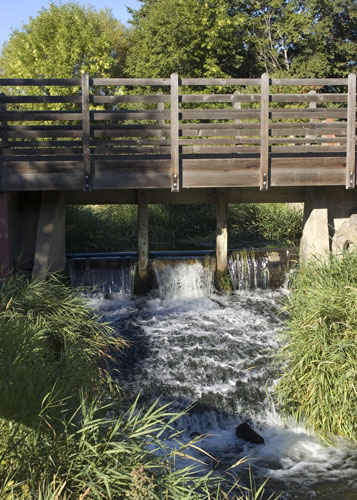
 A weir is a low wall or barrier built across a river, stream, or channel that water flows over the top of. It raises the water level upstream and controls or measures the flow, while letting water spill over the crest continuously. A dam is built to hold water back and store it, and water normally passes through gates or spillways only when operators release it. Weirs are used to measure stream flow, keep water deep enough for irrigation intakes and boats, control floods, and create ponds and water features. This page explains how weirs work, the main types, and how to seal and repair a concrete weir so water goes over it instead of through it.
What is a weir?
A weir (pronounced “weer”) is an overflow structure. Water backs up behind it until it reaches the top edge, called the crest, and then pours over. The sheet of water falling over the crest is called the nappe. Because the depth of water flowing over a weir of known shape relates directly to the flow rate, engineers and hydrologists use weirs to measure how much water a stream or channel carries.
The word comes from Old English and has been used for river barriers for centuries. Mill weirs once raised rivers to feed water wheels, and fish weirs were fences or traps placed across streams to catch fish. Today you will also hear the term in pools (the flap on a skimmer is called a weir), aquariums (overflow weirs), and water treatment plants (the notched edges that water spills over in settling tanks).
Weir vs. dam: what is the difference?
- Purpose. A dam stores water in a reservoir for water supply, power, or flood control. A weir raises the water level a modest amount, controls flow, or measures it.
- Height. Weirs are usually low, often only a few feet high. Dams can be hundreds of feet tall.
- Flow. Water flows over the full width of a weir crest whenever the upstream level is above it. A dam controls release through gates, outlets, and spillways.
- Size of the pool. A weir creates a small pool upstream. A dam creates a large reservoir.
The line between the two blurs at small scale. A low dam that water spills over is often called a low-head dam or weir. These structures carry a serious safety risk: the water falling over them forms a recirculating current at the base that can trap swimmers and boaters. Stay away from the downstream face of any weir or low-head dam, even when the drop looks small.
Types of weirs
Sharp-crested weirs
A sharp-crested weir has a thin plate with a sharp upstream edge, so water springs clear of the crest. These are the standard flow-measuring weirs in canals, streams, and test channels. Common shapes:
- Rectangular weir: a rectangular notch in the plate. Good for moderate to large flows.
- V-notch (triangular) weir: a V-shaped notch, often 90 degrees. Accurate at low flows, because a small change in flow makes a noticeable change in depth.
- Cipolletti (trapezoidal) weir: a notch with sloped sides that simplifies the flow calculation.
Broad-crested weirs
A broad-crested weir has a wide, flat top, usually concrete, that water flows across before dropping off. They are sturdy, handle debris well, and are common in irrigation canals and rivers.
Ogee weirs
An ogee weir has an S-shaped profile that follows the natural curve of falling water. This shape lets large flows pass smoothly, and it is the common form for dam spillways.
Labyrinth and piano key weirs
A labyrinth weir folds the crest into a zigzag pattern of trapezoids or triangles. That packs a much longer crest into the same channel width, so the weir passes more water for the same rise in level. Piano key weirs use a similar idea with overhanging sections. Both are used to increase spillway capacity.
Compound weirs
A compound weir combines shapes, such as a V-notch in the middle of a broad crest. The notch measures low flows accurately and the wider section handles high flows.
What are weirs used for?
- Measuring flow. Agencies such as the USGS and the U.S. Bureau of Reclamation use weirs and flumes to measure stream and canal flow.
- Holding water levels for irrigation intakes, navigation, and water supply.
- Flood control and spillways that pass excess water safely.
- Fish management. Counting weirs guide migrating salmon and other fish past counting stations, and some weirs block invasive species.
- Water features. Garden ponds, fountains, and spillway walls use small weirs to create a smooth sheet of falling water.
Why weirs leak and need waterproofing
A weir only works if water goes over the crest. Water that seeps under the weir, around its ends, or through cracks in the concrete is called underflow or bypass. It throws off flow measurements, lowers the pool level, and over time washes soil and fines out from under the structure, which can undermine it. Small weirs in ponds and fountains show the same problem as a pool that drops overnight or a spillway that runs dry.
Common causes of leaks:
- cracks from freeze-thaw cycles, settling, and shrinkage
- cold joints between pours and between the weir and its wing walls
- gaps where the weir plate or boards meet the concrete
- porous, worn concrete that has lost its surface
- failed sealants and coatings that cracked or peeled under constant water pressure
A weir faces constant moving water, wet and dry cycles at the waterline, debris, and ice. A sealer for this job has to bond to the concrete, stretch across cracks as the structure moves, and stay intact while submerged.
How to seal and repair a concrete weir
SANI-TRED is a liquid rubber that soaks into concrete, bonds to it, and cures into a seamless rubber membrane. It is used to seal ponds, fountains, pools, and tanks, and it is harmless to plants, fish, and other aquatic life once cured. The same process works on concrete weirs, spillway walls, and overflow boxes. The work has to be done dry, so divert or drain the water first.
1. Drain and dry
Lower the water below the work area with a cofferdam, sandbags, or a pump bypass. The surface must be completely dry before you coat it.
2. Prepare the surface
Remove algae, loose concrete, old coatings, and debris. The concrete must be clean, dry, and free of previous products. Acid etch smooth or tooled concrete and neutralize it as described in how to acid etch concrete.
3. Prime
Apply one coat of PermaFlex at about 240 square feet per gallon. Concrete block needs two prime coats.
4. Patch and profile
Mix 2 parts LRB (Liquid Rubber Base) with 1 part TAV (Thickening Activator) to make a thick rubber patching compound. Fill cracks (most take a 3/4-inch bead), run a 1-inch bead where walls meet the floor, and seal joints and the edges around any weir plate or boards. The crack filling calculator estimates how much you need.
5. Topcoat
Apply one coat of PermaFlex at about 240 square feet per gallon. If the water will be treated with chlorine or other chemicals, add at least one coat of a good 2-part epoxy pool paint over the cured rubber for chemical resistance and color.
6. Cure and refill
Let the system cure fully according to the product instructions before you restore flow.
SANI-TRED for weirs, ponds, and water features
The products are solvent free, non-flammable, and low VOC, and they come with detailed instructions and phone support for DIY projects. The same system seals garden ponds, fountains, and spillways at home.
- See the fountain and pond sealing system
- Follow the steps in how to repair or waterproof a fountain or pond
- Review the basic product line and price list
- Try a sample pack backed by a Double Your Money Back Guarantee
- Call 1-866-784-3308 to talk with a SANI-TRED tech about your project
Frequently asked questions
What is a weir in simple terms?
A low wall across a river or channel that water flows over. It raises the water level behind it and lets engineers control or measure the flow.
What is the difference between a weir and a dam?
A dam holds back and stores water, and releases it through gates or spillways. A weir is usually lower, creates a small pool, and lets water flow over its full crest.
Why are weirs dangerous?
Water falling over a weir or low-head dam can form a recirculating current at the base that pulls people back toward the wall. Stay well clear of the downstream side.
How does a weir measure flow?
For a weir of known shape, the depth of water above the crest, measured a set distance upstream, relates directly to the flow rate. Standard equations or tables convert that depth to flow.
What is a V-notch weir used for?
Measuring small flows accurately. The narrow V means a small change in flow produces a noticeable change in water depth.
How do you stop a weir from leaking?
Drain the area, clean and dry the concrete, then seal cracks, joints, and the full surface with a bonded, flexible waterproofing system such as SANI-TRED.
Sources: U.S. Bureau of Reclamation, “Water Measurement Manual”; U.S. Geological Survey.