
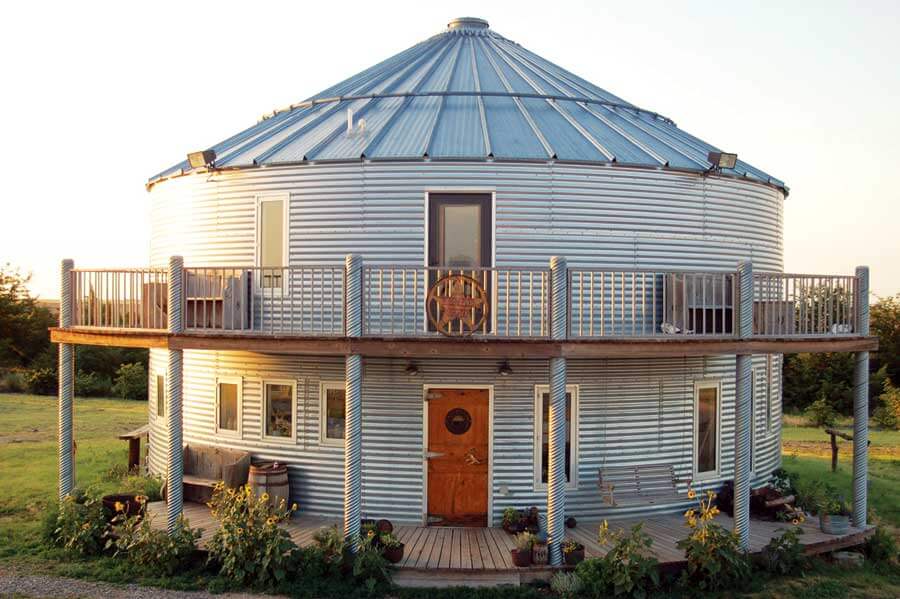
 Affordable housing is hard to secure these days, but with a little imagination and DIY skills, folks around the United States are looking to a new way to modify an old farm staple: Grain Bins. Making a grain silo home is not an easy task, but it is an affordable option that many are turning to in order to house their families. Learn how to build a grain bin house for your property with the information below.
Many grain bins in rural and farming communities are standing empty these days as farmers use other means of storing corn, hay, and grain. A grain bin home will cost approximately $200 per square foot, and one has even been constructed for as low as $9,000. This is a dramatic difference when compared to real estate prices. Grain silo homes are also easier to heat, more efficient, and a lot of fun can go into designing a one of a kind home.
Mark Clipsham is an innovative designer working on a project that would put one small grain bin into a large one, and then insulating the space in between. This solves a great dilemma in climates like the Great Plains, and Northern parts of the U.S. and Canada, that have colder and longer winters.
There are literally dozens of Grain Silo Home plans across the internet, but the one with greatest credibility is one published by Mother Earth News in 2010. Since that article, Grain Bin Homes are popping up everywhere, and it is easy to see why. The first step is to find the right bin or bins. It is also easy to connect bins with inexpensive walkways. If you have your own, on your own property, you are a step ahead. If not, you will have to locate some empty bins in your area in order to build a grain bin house. If you need to move them, depending on size, some can be moved in one piece on a flatbed truck. Others will need to be taken apart, and later reconstructed on your land.
Finding, moving, and sizing a grain bin
To find used bins, put an ad in farm magazines, check Craigslist, or talk to a local bin dealer or bin erector. Companies that sell and install bins can usually move them as well. Bins up to 36 feet in diameter can be moved in two pieces and reassembled on site. Larger bins usually need a more extensive tear down and transport.
If you take a bin apart to move it, label every sheet as it comes off. The gauge (thickness) of the steel is usually mixed within the same bin, with thicker metal toward the bottom, so each sheet has to go back in the same place. Use new bolts when you reassemble the bin.
Grain bins are sold by bushel capacity, but for a house you need the floor area. Use Area = 3.14 x (radius x radius), where the radius is half the diameter. A bin 30 feet in diameter has a 15 foot radius, so its area is 3.14 x (15 x 15) = 706.5 square feet. The grain bin calculator works out how much SANI-TRED you need to seal it.
Once the bins are on your land, you can start creating your own vision in your head and draw out grain bin house plans. If you prefer, several sites sell plans, so all you have to do is follow them or have a contractor do so. If you do not do the two bin (a smaller in a larger) philosophy, you will need to figure out a good way to insulate the home. You will also want to make sure all roofs are securely fastened, and that there are no leaks. Do this prior to starting on the interior work. Solar panels added at this time will provide heating and energy when installed properly.
One of the hardest hurdles is installing electric and water lines. These codes vary from state to state and in Canadian Provinces. One of the best ways to plumb a grain bin is to use polyethylene tubing instead of copper; this also helps pipes not to freeze as fast. Since grain bins are metal, it is necessary to ensure the building remains safe from lightning strikes. Use two industrial grounding rods (or more if you have multiple bins hooked together), run with separate copper grounding wires throughout the grain building.
Hiring a licensed plumber and electrical contractor is a must, not only due to laws, but also for safety and to ensure that your new Grain Bin Home will bring you years of family fun.
After you’ve made sure your Grain Bin Home’s overall construction is complete, it’s time to put up some walls. This is where your design talents can shine. Creating the kitchen, living space, and bedrooms, is fun for the whole family. Kids will feel a greater sense of pride in their home, when they know that they had a say in the division of space. The next step is to start putting fixtures in the grain silo home, like sinks, showers, closet structures, kitchen appliances, light fixtures, and room dividers.
Expect the trend of Grain Bin Homes to continue to grow and advance as families look for more economical and environmentally friendly options. Grain Bin Houses can be a great way to try out your inner “designer” or “architect” dreams, so have at it, be creative. Here are some plans on how to build a grain bin house to get you started http://www.dreamgreenhomes.com/plans/bincabin.htm.




Grain bin home floor repair and resurfacing
Many grain bins sit on old concrete slabs that are cracked from years of farm use. Duwayne Molden of Molden Concrete in Minnesota was hired to resurface an extremely cracked slab in a Grain Bin Home remodel. He used the SANI-TRED floor system, with its 590% elongation, because it could handle even badly cracked concrete and cost far less than tearing out and replacing the slab.
Duwayne filled the cracks with SANI-TRED’s Quick Patch, then applied two coats of PermaFlex. He broadcast colored flakes into the PermaFlex and topcoated it with SANI-TRED’s Industrial Perfect Poly 90 Sealer. The customer loved the new look of the floor, and Duwayne was satisfied the slab would give many years of service without failure. The same approach works on garage and shop floors; see garage floor coating and resurfacing.


Seal Your Grain Bin With SANI-TRED
Permanently bond, waterproof, and seal metal grain bin surfaces for about half the cost of silicone caulk. SANI-TRED waterproofing products provide an industrial quality flexible base seal which permanently bonds to and seals all grain bin surfaces yet expands and contracts with temperature changes & fill cycles. Our grain bin sealant product is endorsed by the world’s largest grain bin manufacturers including Brock/Butler for their new commercial bins. To find out more about how to build a grain bin home and grain bin sealing & repair with SANI-TRED, call 1-866-949-2011.
A grain bin house has to deal with water like any other home. Seal the seams and bolt lines on the walls, and the joint where the bin meets the concrete base, before you insulate and finish the interior. The products are solvent free, non-flammable, and low VOC, and they come with detailed instructions and phone support.
- Follow the steps in how to seal a grain bin
- See the grain bin sealing and repair system
- Estimate materials with the grain bin calculator
- Try a sample pack backed by a Double Your Money Back Guarantee from the shop
- Call 1-866-784-3308 to talk with a SANI-TRED tech about your grain bin home