
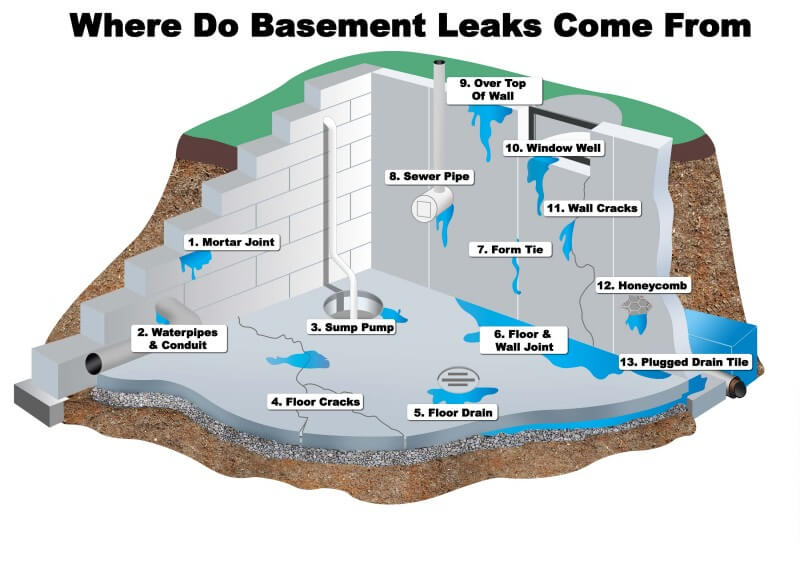
 Water seepage in a basement almost always comes from water in the soil outside pushing through the concrete. Rain and snow melt soak the ground next to the house, the wet soil presses on the walls and floor, and the water finds the weakest spot: a crack, the joint where the wall meets the floor, a pipe hole, or the pores of the concrete itself. Less often the water starts inside the house, from a plumbing leak or from humid air condensing on cool walls. This guide walks through each cause, how to tell which one you have, and how to fix it.
How to tell where the water is coming from
Before you spend money, figure out whether the water is coming through the concrete or forming on it. Tape a 2 ft by 2 ft square of plastic sheeting or aluminum foil tight to the wall on all four edges. Leave it for two or three days.
- Wet on the side touching the wall: moisture is moving through the concrete from the soil. That is seepage.
- Wet on the room side: humid air is condensing on a cool surface. That is condensation, and it calls for a dehumidifier and better air flow.
Also look at the pattern. Water at the bottom of the wall after a storm points to the floor-wall joint. A damp ring a foot or two up the wall, white chalky crust (efflorescence), or peeling paint points to water moving through the concrete. A wet ceiling or a wet wall under a bathroom points to plumbing.
Common signs of water seepage in a basement
- Puddles along the base of the walls after rain
- Damp or dark patches on block or poured walls
- White, powdery efflorescence on the concrete
- Paint or waterproofing coatings that bubble and peel
- A musty smell, mildew, or mold on walls, boxes, or carpet
- Rusty nails, rotting sill plates, or warped wood paneling
- Condensation on walls, floors, and cold water pipes
What causes leaky basements
1. Hydrostatic pressure
Hydrostatic pressure is the weight of water in saturated soil pressing against the foundation. Water weighs about 62.4 pounds per cubic foot. Each foot of water depth adds about 0.43 psi, so a wall with 7 feet of saturated soil against it carries roughly 3 psi at the bottom, or more than 400 pounds on every square foot. That pressure forces water through cracks, tie holes, and the pores in concrete. It is the most common cause of basement leaks and floor seepage, and it is the reason a basement can stay dry for months and then leak after a week of rain.
Some contractors talk about “negative” hydrostatic pressure. They mean water pushing on the back side of a wall or slab, from the soil toward the room. Coatings applied to the inside of the wall have to hold against that push. Most paints cannot, which is why they blister.
2. Cracks and holes in the foundation
Concrete shrinks as it cures, and soil settles over the years, so most foundations develop cracks. Water does not need a wide crack. Under pressure it will travel through a hairline crack, an old form tie hole, or the gap around a pipe or wire that passes through the wall. Basement windows and their frames are another common entry point. See basement crack repair options for how to fill them.
3. The floor-wall joint (cove joint)
Most basements are poured in two stages: the footing and walls first, then the floor slab. The seam where they meet is a cold joint that never bonds. When the water table rises or the footing drain backs up, water comes up through that joint and spreads across the floor. If your water shows up at the base of the walls and nowhere else, start here.
4. Gutters and downspouts
One inch of rain on a 2,000 square foot roof produces about 1,250 gallons of water. Gutters and downspouts collect all of it at a few points around the house. If gutters overflow from leaves and dirt, or downspouts dump water against the foundation, that water goes straight into the soil next to your basement walls. Clean the gutters at least twice a year and extend downspouts at least 4 to 6 feet from the house.
5. Poor grading
The soil around the house should slope away from the foundation. The International Residential Code calls for the ground to fall at least 6 inches within the first 10 feet. Backfill around a new house often settles, and over time the slope flattens or reverses. Then rain flows toward the walls instead of away. Some houses also sit in a low spot where water naturally collects, which makes grading even more important.
6. Clogged or missing footing drains
Many homes have a perforated drain pipe at the footing that carries ground water to a sump or to daylight. Soil, silt, and tree roots clog these pipes over the years. Once a footing drain stops working, water builds up around the foundation and pushes in through the floor-wall joint. Older homes, especially those built when basements were for storage, may have no footing drain at all. Read the pros and cons of an interior footing drain if you are weighing one.
7. Sump pump failure
A sump pump that fails during a storm, often because the power is out, lets the pit overflow and floods the floor. Check the float and test the pump each spring by pouring a bucket of water into the pit. A battery backup covers power outages. More on that in the pros and cons of sump pumps.
8. Window wells
A window well without a drain, or one filled with leaves, turns into a bucket that holds water against the window. When it fills past the sill, water pours in. Keep wells clear, make sure the drain at the bottom works, and add a cover if the well collects a lot of debris. See waterproofing egress windows and wells.
9. Water vapor through the concrete
Even a wall with no cracks can let water in. Concrete is porous, and water vapor moves through it from the damp soil to the drier air inside. This is called moisture vapor transmission. You may never see standing water, but you get damp walls, efflorescence, peeling paint, and a musty smell. It is also the reason carpet and wood flooring laid directly on a basement slab often fail.
10. Water from inside the house
Rule out the simple causes first. Look for leaking supply lines, a dripping water heater, a washing machine hose, or a toilet or shower above the basement. Check that the dryer vents outside and that the air conditioner condensate line drains properly. These leaks are usually easy to fix, and the moisture goes away once you do.
11. Condensation
In summer, warm humid air meets the cool basement walls and floor, and water forms on them the way it forms on a cold glass. Opening basement windows on a humid day makes it worse. Run a dehumidifier, keep relative humidity under 50 percent, insulate cold water pipes, and use exhaust fans in basement bathrooms and laundry rooms.
Why basements leak more in winter and spring
A heated basement warms the soil next to the walls. Snow and frozen ground near the foundation melt first and hold water right against the concrete, while the soil farther out is still frozen and cannot drain. Frozen downspout extensions back up and dump water at the corners of the house. Clay soil, which holds water longer than sand or gravel, makes all of this worse. Keep downspouts open through the winter and shovel snow a few feet away from the foundation when you can.
How to stop water seepage in a basement
Fix the outside first, because it is cheap and it lowers the amount of water pushing on the walls:
- Clean gutters and extend downspouts 4 to 6 feet from the house.
- Rebuild the grade so soil slopes away from the foundation.
- Keep window wells clear and make sure they drain.
- Fix plumbing leaks and run a dehumidifier.
- Test the sump pump and add a battery backup if storms knock out your power.
If water still comes through, you have three main choices: dig out and coat the outside of the walls, install an interior drain and sump that collects water after it gets in, or seal the inside of the walls and floor so water cannot pass through. Each has trade-offs in cost and disruption, covered in basement waterproofing options compared. For the inside approach, see how to waterproof basement walls from the inside.
Seal the concrete so water cannot get through
Drains and sump pumps manage water after it has entered. SANI-TRED stops it at the concrete. The liquid rubber soaks into the concrete, bonds to it, and cures into a seamless rubber membrane that holds back water under hydrostatic pressure and stops water vapor. It also blocks 99 percent of radon gas.
The DIY process is prep, prime, patch, and topcoat. PermaFlex is the primer and topcoat. Two parts LRB (Liquid Rubber Base) mixed with one part TAV makes a rubber patching compound for cracks, tie holes, and the floor-wall joint. The products are solvent free, non-flammable, and low VOC, and they carry a lifetime warranty.
- See the basement waterproofing system
- Get a materials list from the basement waterproofing cost calculator
- Try a sample pack, backed by a Double Your Money Back Guarantee
- Call 1-866-784-3308 to talk with a SANI-TRED tech about your basement
Frequently asked questions
Why does water come up through my basement floor?
Water under the slab rises when the water table goes up or the footing drain is clogged. It usually enters at the floor-wall joint, through cracks in the slab, or around floor drains and pipes. Hydrostatic pressure pushes it up from below.
Why does my basement leak only when it rains hard?
Heavy rain saturates the soil faster than it can drain. Pressure builds against the walls and floor, and water finds the weak spots. Overflowing gutters and short downspouts often make the difference between a dry basement and a wet one.
Is a little water seepage in a basement normal?
It is common, but it is not harmless. Steady dampness feeds mold, rots wood framing and sill plates, ruins stored items, and makes a finished basement impossible. Find the source and fix it while it is small. See how to get rid of black mold in a basement if mold has already started.
Can basement walls leak without visible cracks?
Yes. Concrete and block are porous, and water vapor moves through them. Damp patches, efflorescence, and peeling paint on a wall with no cracks are signs of moisture vapor transmission.
Will homeowners insurance cover water seepage in a basement?
Most standard policies exclude gradual seepage and ground water. They may cover sudden damage from a burst pipe. Read your policy and ask your agent, since coverage varies by insurer and state.
Sources: USGS Water Science School, “Rain and Precipitation” and “Water Density”; International Residential Code, Section R401.3; U.S. EPA, “A Brief Guide to Mold, Moisture, and Your Home.”